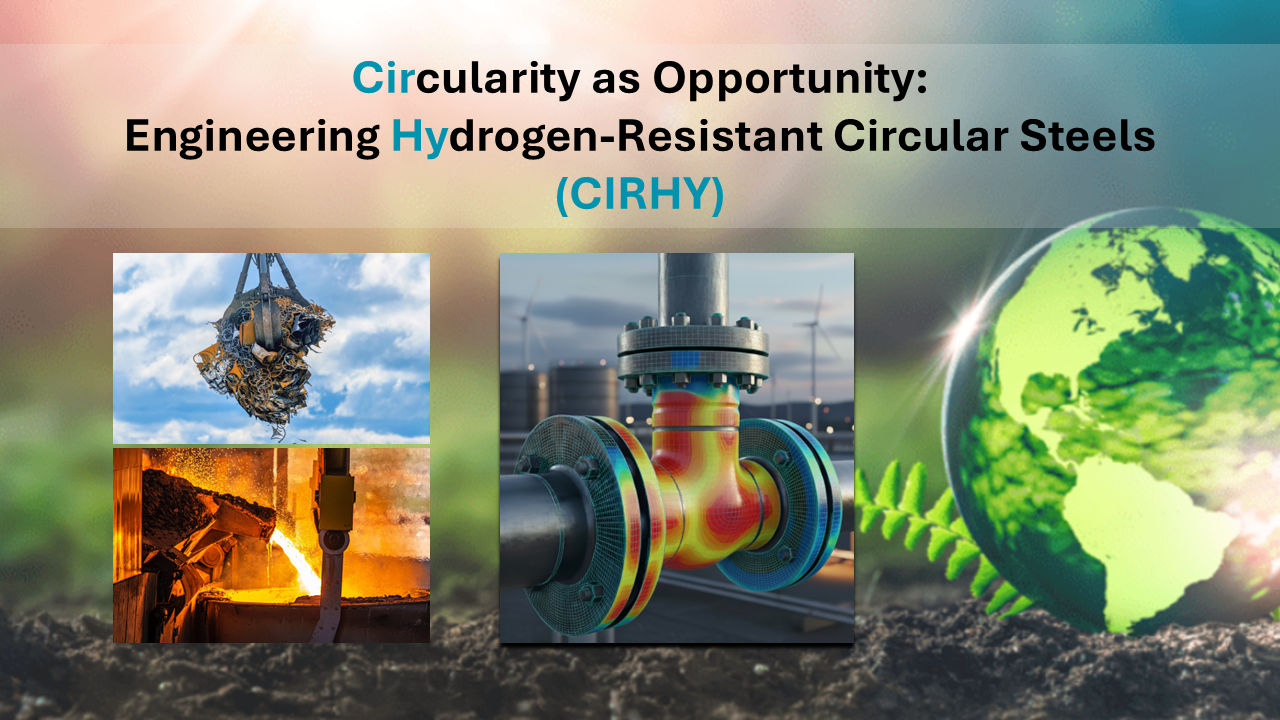
CIRHY is a six-year research and innovation project focused on enabling circular steels to operate safely in hydrogen environments. The project was granted by the Dutch national funding agency NWO in 2025 under project number P24.058.
Hydrogen can penetrate steel and cause embrittlement, reducing ductility and potentially leading to cracking and structural failure. At the same time, the shift towards circular steels produced from recycled materials is essential to reduce CO₂ emissions and reliance on primary resources.
CIRHY brings these challenges together. The inherent variability of recycled steel, including the presence of residual elements, is investigated as a potential design lever. Understanding these elements could reveal ways to improve resistance to hydrogen damage, for example through beneficial hydrogen-trapping mechanisms.
The project combines advanced experiments with physics-based modelling across atomistic, mesoscopic and macroscopic scales. It connects microstructural features and residual elements to mechanical performance, translating fundamental knowledge into predictive design capabilities.
CIRHY builds on initiatives such as DEPMAT and Growing with Green Steel. It complements their work on recycled materials by addressing the impact of hydrogen on steel performance in the presence of residual elements.
 CIRHYCircular steel